
The Eiffel Project

well I'm awake now... ... let's go back to work ...

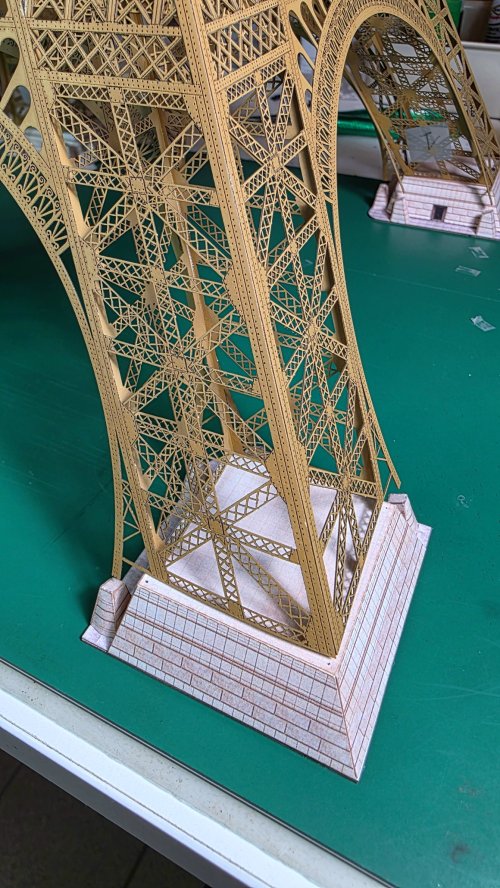
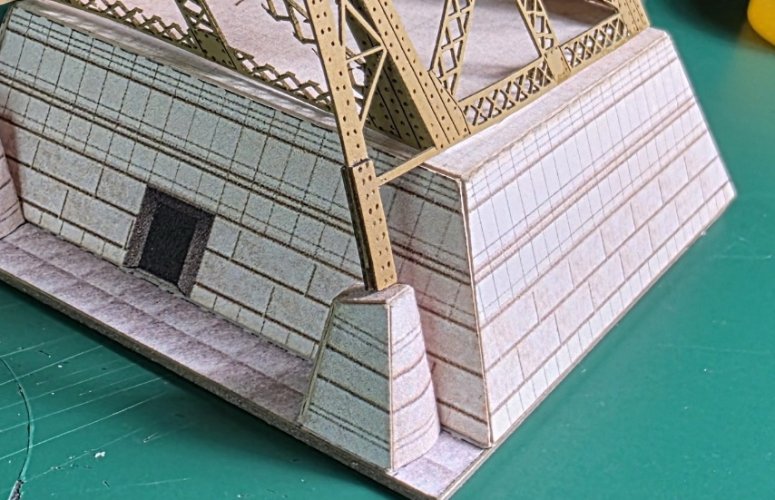
The main base structure is now almost complete. I should give her shoes now lo let her stand up on her legs.

20251018_164959.jpg

But there are two problems:
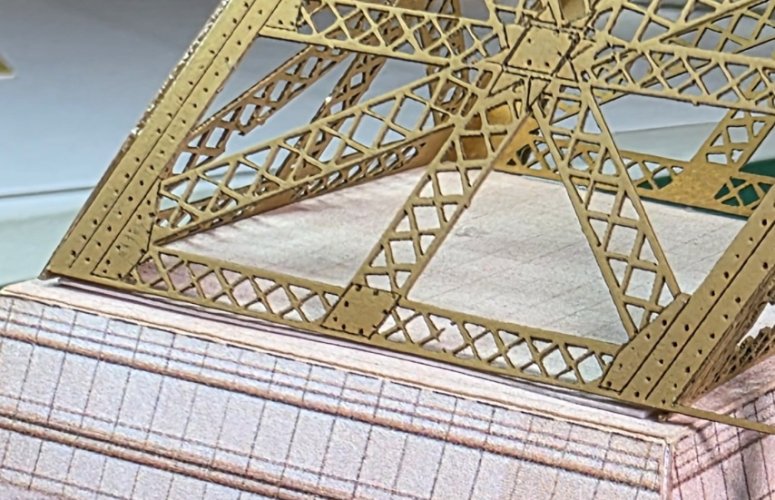
1) the contact points between the base and the "leg" are too little and discontinuous
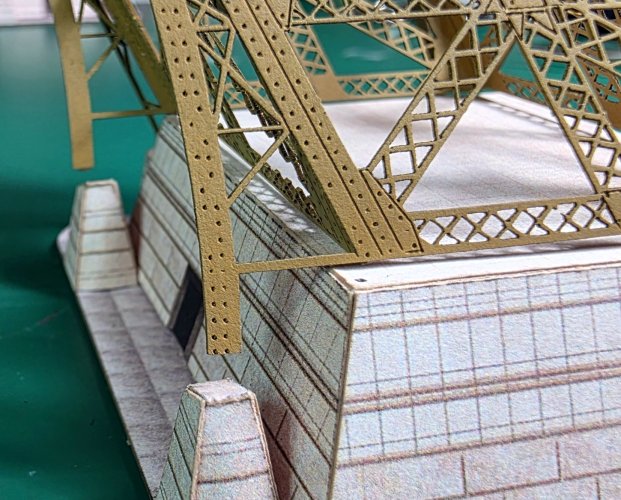
2) the curve beam doesn't reach the base block where it is supposed to be joined

20251018_165016.jpg

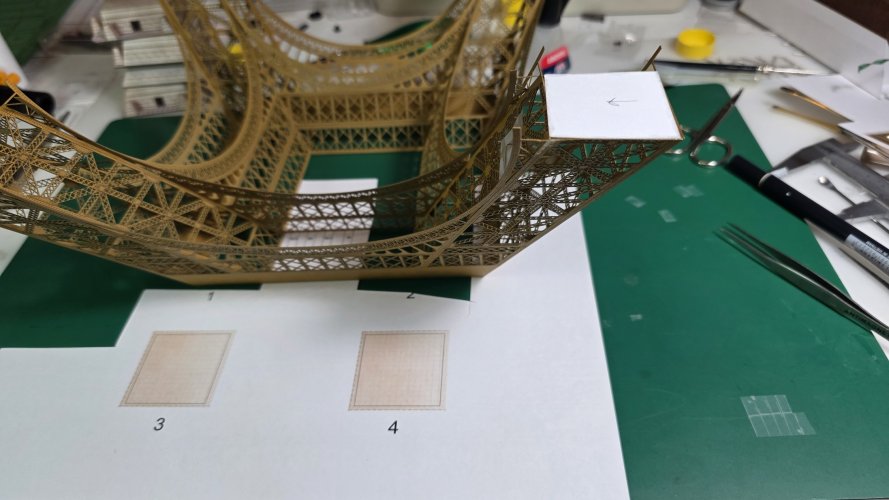
To front the first problem I realized four squares with the same texture of the base and the exact dimension of the aperture inside the "leg". Those can be joined with the structure much easily putting the glue along the edges and creating a solid base.

20251018_165138.jpg

Once glued to the base the new added pieces are barely visible.

20251022_181057a.jpg

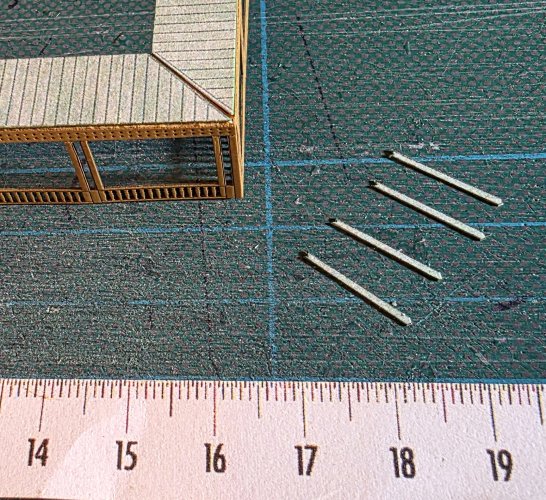
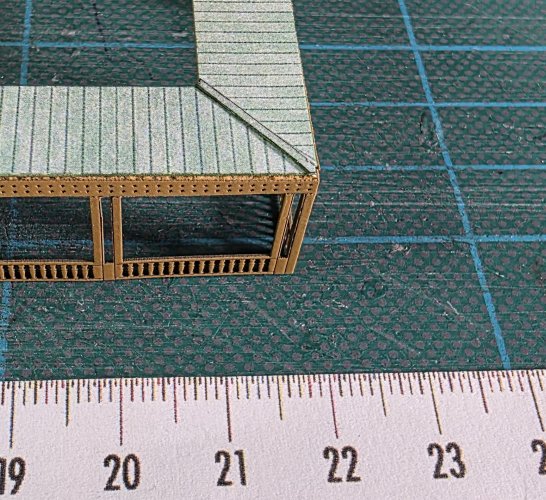
For the second issue I was forced to create little sections of beam to prolonge the short ones. This is a detail not very realistic but I wasn't able to think anything better

20251022_181027a.jpg

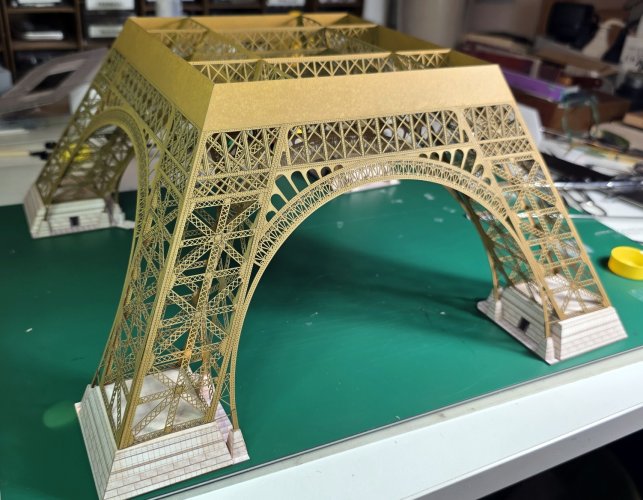
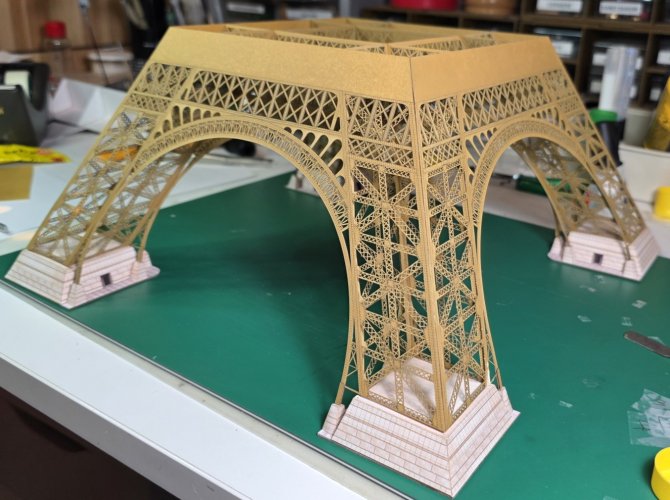
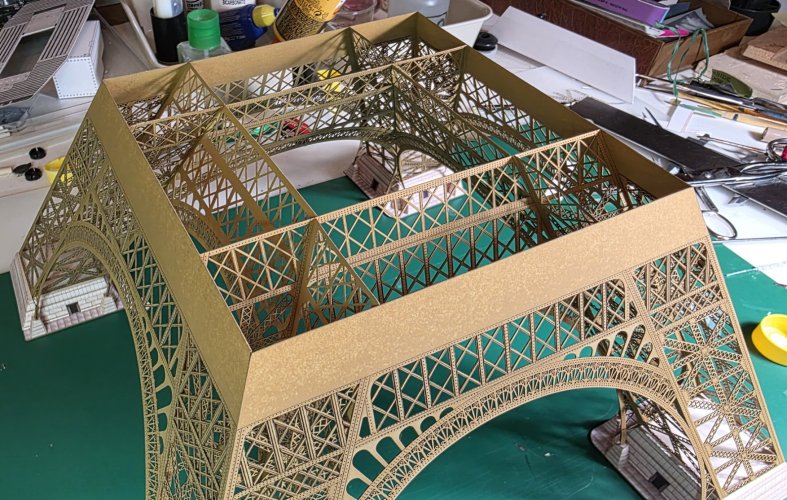
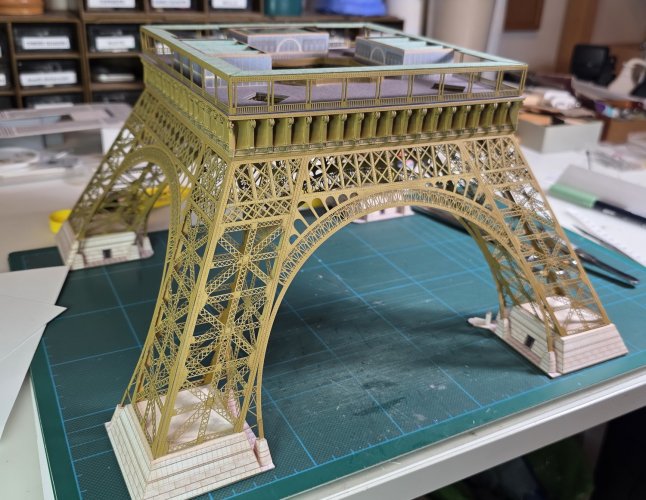
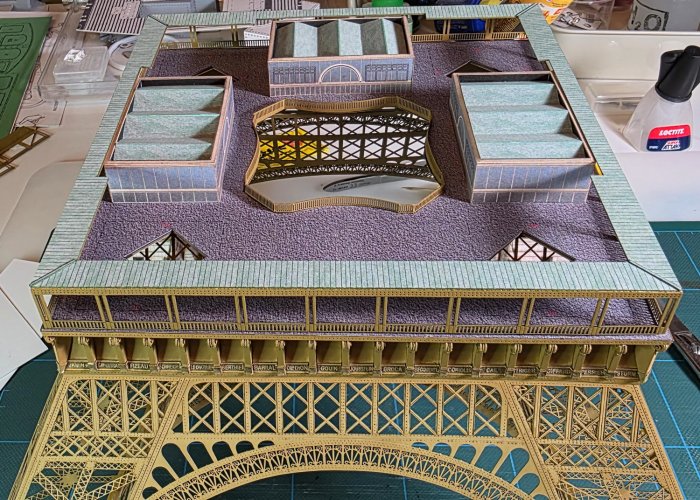
And so this is the point I reached so far. I'm satisfied with the result: I was afraid the thing to be too fragile, the pieces are so delicate... but once joined in this complex structure they form a very light and strong base, just like the real counterpart I think.

20251022_181140.jpg
20251022_181155.jpg
20251022_181350.jpg
 
Last edited:
well I'm awake now... ... let's go back to work ...

The main base structure is now almost complete. I should give her shoes now lo let her stand up on her legs.

View attachment 228584

But there are two problems:
1) the contact points between the base and the "leg" are too little and discontinuous
2) the curve beam doesn't reach the base block where it is supposed to be joined

View attachment 228585

To front the first problem I realized four squares with the same texture of the base and the exact dimension of the aperture inside the "leg". Those can be joined with the structure much easily putting the glue along the edges and creating a solid base.

View attachment 228617

Once glued to the base the new added pieces are barely visible.

View attachment 228599

For the second issue I was forced to create little sections of beam to prolonge the short ones. This is a detail not very realistic but I wasn't able to think anything better

View attachment 228600

And so this is the point I reached so far. I'm satisfied with the result: I was afraid the thing to be too fragile, the pieces are so delicate... but once joined in this complex structure they form a very light and strong base, just like the real counterpart I think.

View attachment 228601
View attachment 228602
View attachment 228603
Love the fix!
I'm sure that Mr. Eiffel is grinning somewhere in heaven
!
 
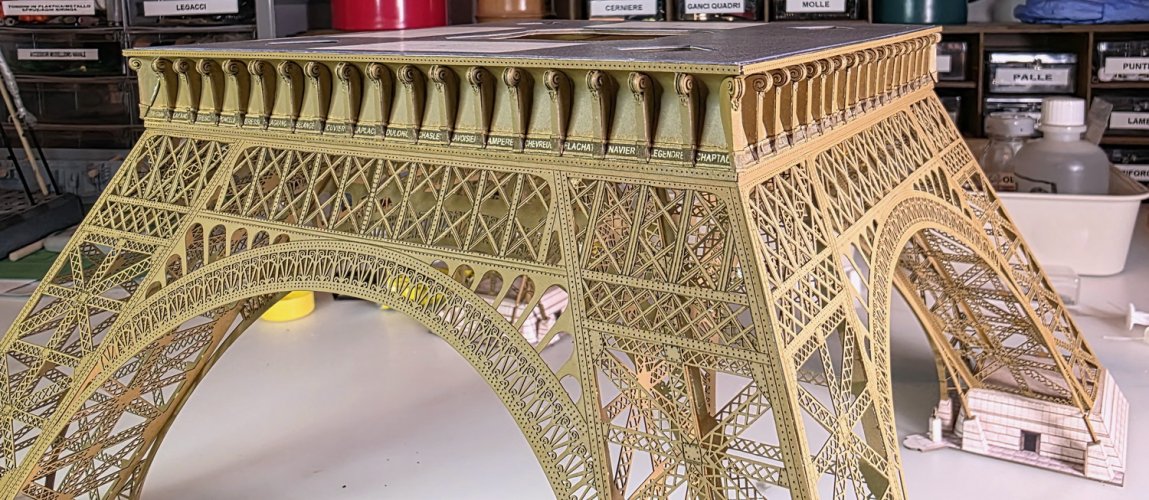
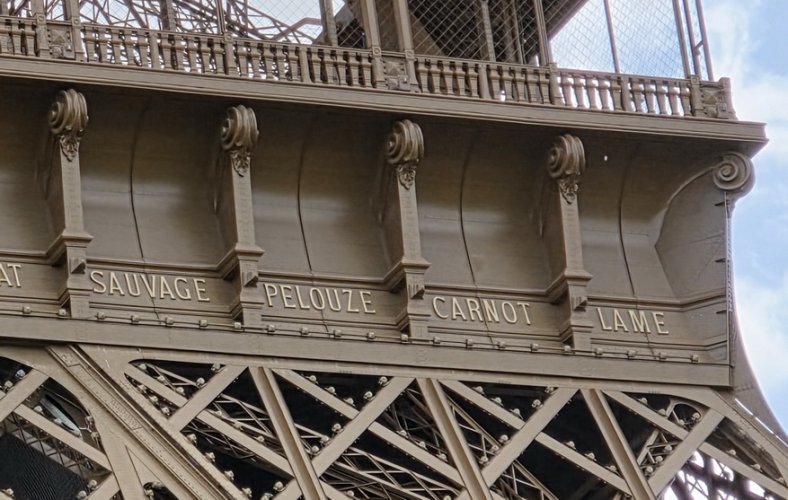
Hi my friends, I start this new modeling year with a rich update to my Eiffel Project. Last weeks I was very busy trying to resolve several little problems in one of the most interesting spots of this build. When I was in front of the real thing I was very impressed by the details surrounding the structure under the first platform.

20250602_151359B.jpg

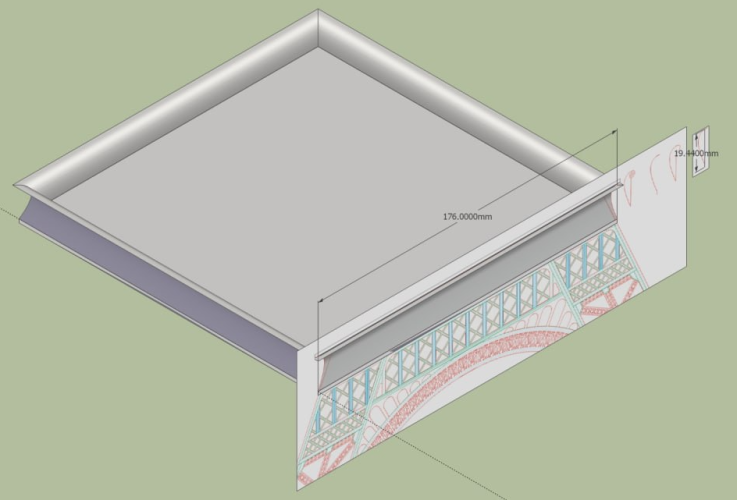
This is a part of the model that, in the Schreiber interpretation, was a little underestimated. It was represented by a flat piece with approximative drawings of the details to give a sort of 3D feeling with little success, in my opinion. This was not enough for my purposes.
Immagine 2026-01-02 161656.png
To give it a real 3D structure I had to face with several problems. First of all I had to figure how to realize the curved walls that you can see in the photo. Not a complex piece to do but to figure how the walls intersecate in the corners it was necessary to draw the part in a 3D drawing software (a task I'm not able with). My friend Nando was happy to help drawing the walls for me and exporting the shapes in a form I was able to manage.

Immagine 2026-01-02 160226.png

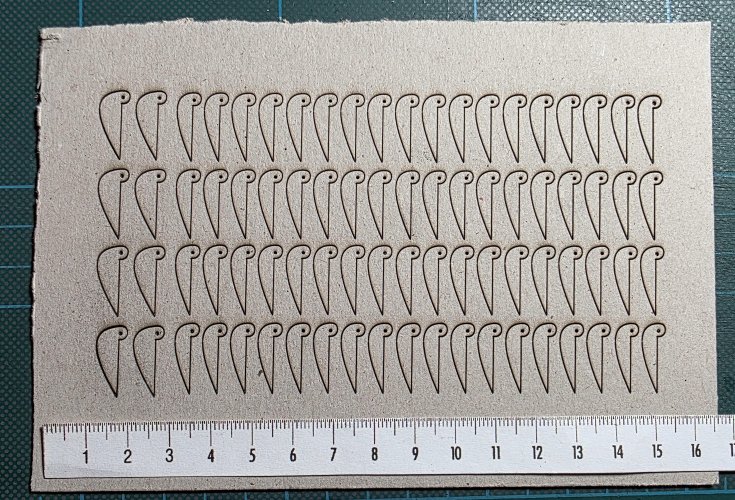
Resolved the first problem there was another one ready to be examined. The supports with those decorated "curls": how to reproduce them in cardboard?
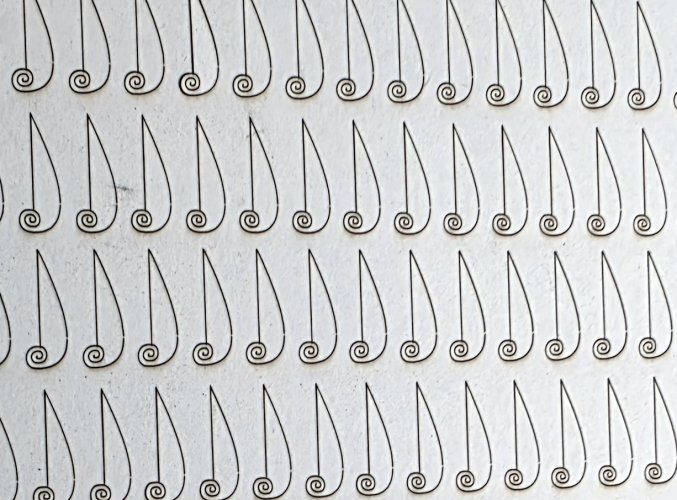
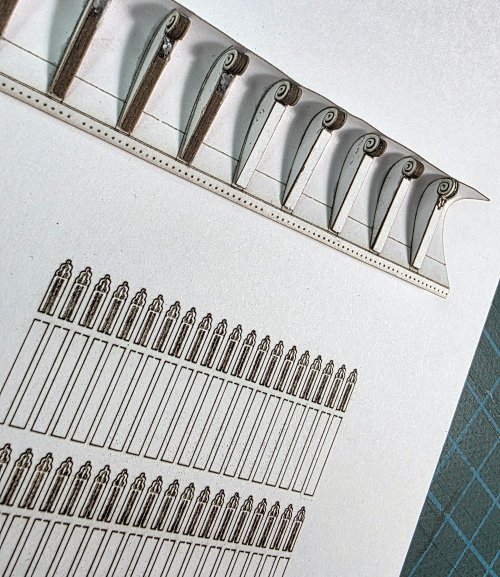
I first cut the main shapes in a 1,5 mm cardboard (always with a little help from my laser)

20251101_122255.jpg

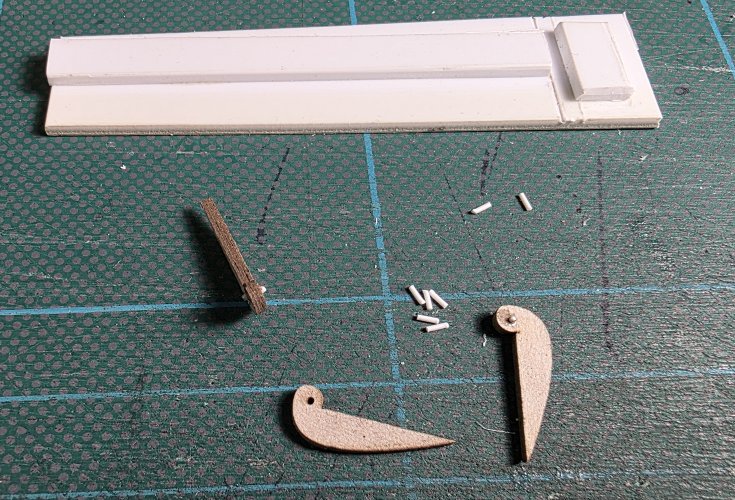
Then I put little pieces of plastic rod (2 mm lenght and 0,5 diameter) in the hole previously provided for this purpose and blocked them with CA glue

20251101_181212.jpg

Then i lasercut the side walls in thinner cardboard (200 g/m2)

20251104_150252.jpg

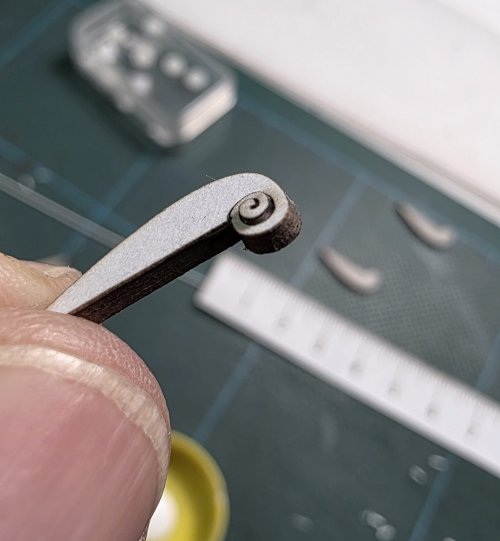
The idea was to push outwards the curls to give them the right shape, this way:

20251104_150503.jpg

...and the plastic rods do the work perfectly...

20251104_153025.jpg

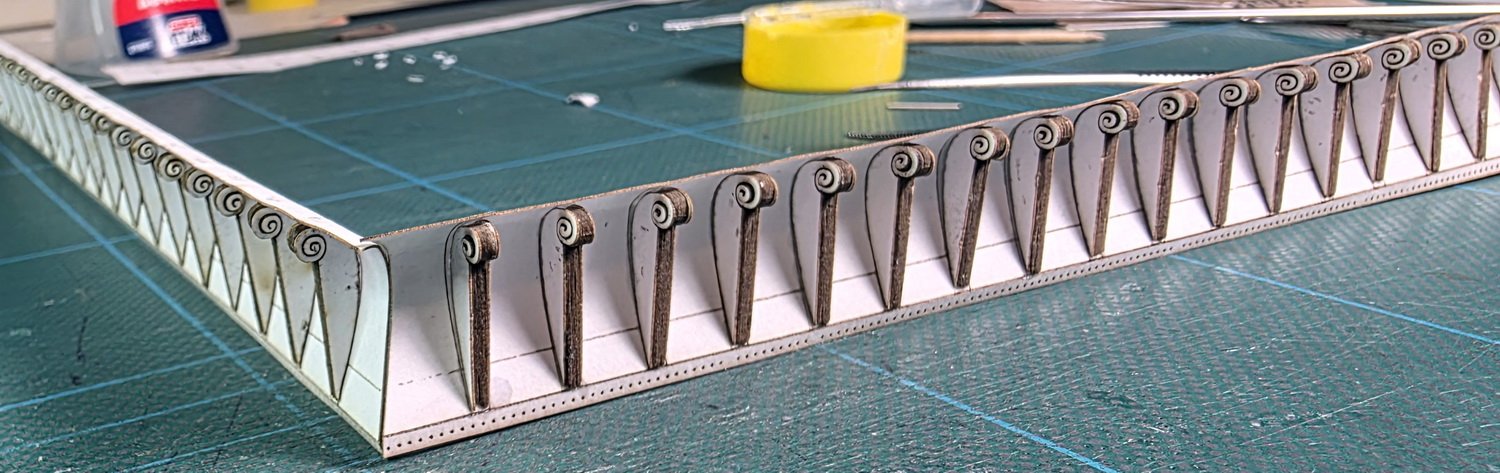
The thing is taking shape...

20251105_183001.jpg
 
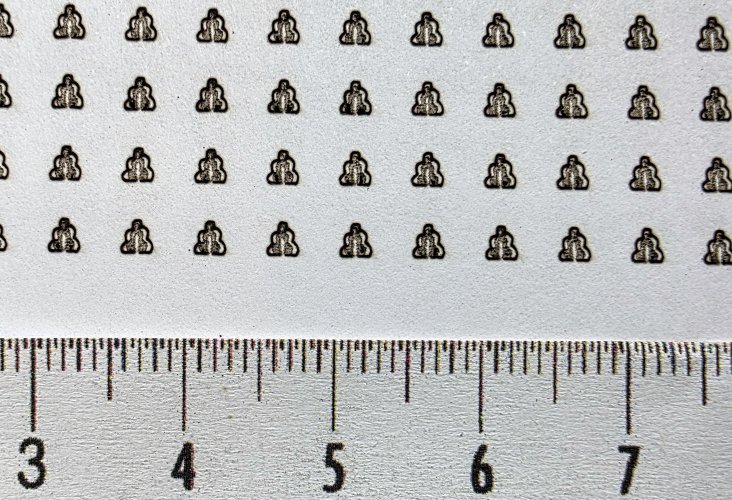
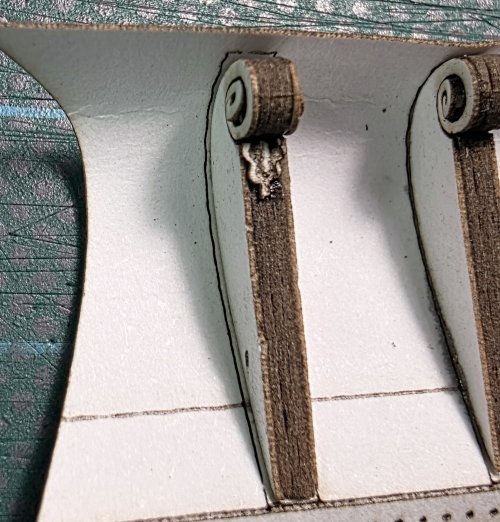
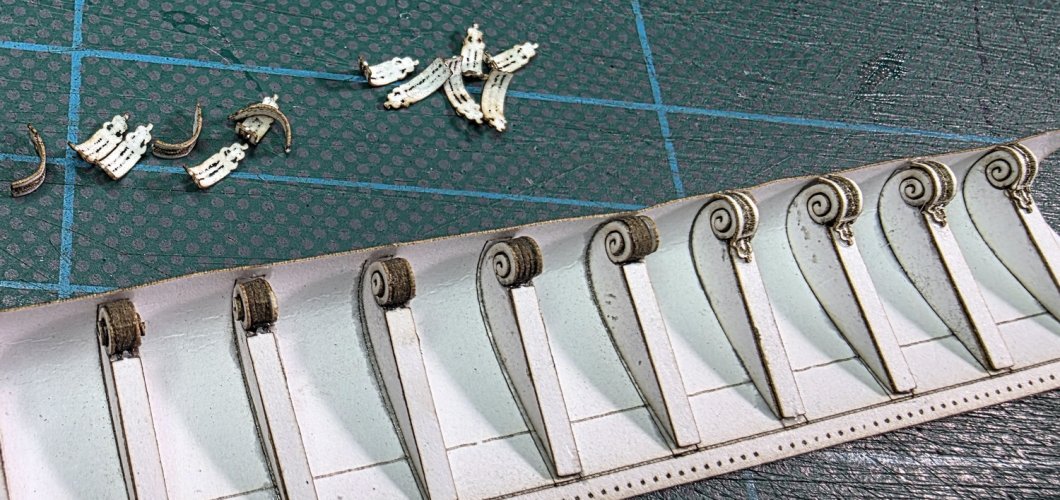
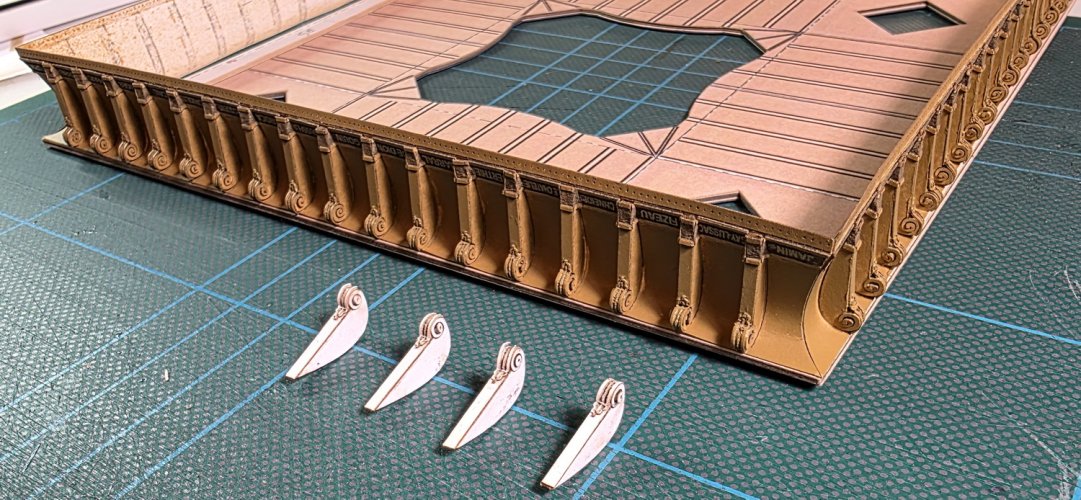
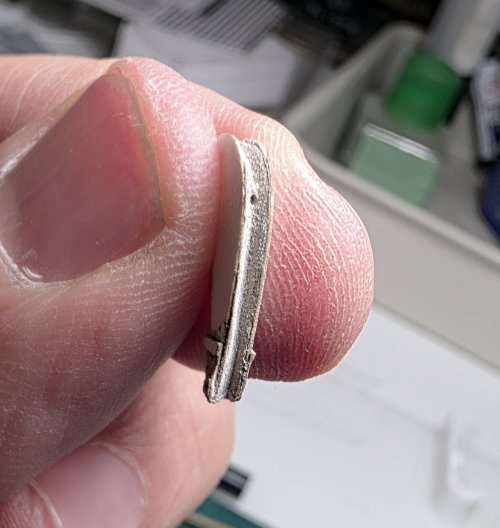
... and, just to add troubles to my work, I thought it would be nice to add the decorative leaves...

20251108_191042.jpg

The laser did the hard work but also I had my part: to manipulate and paste those little things was not an easy task with my big fingers...

20251108_191105.jpg

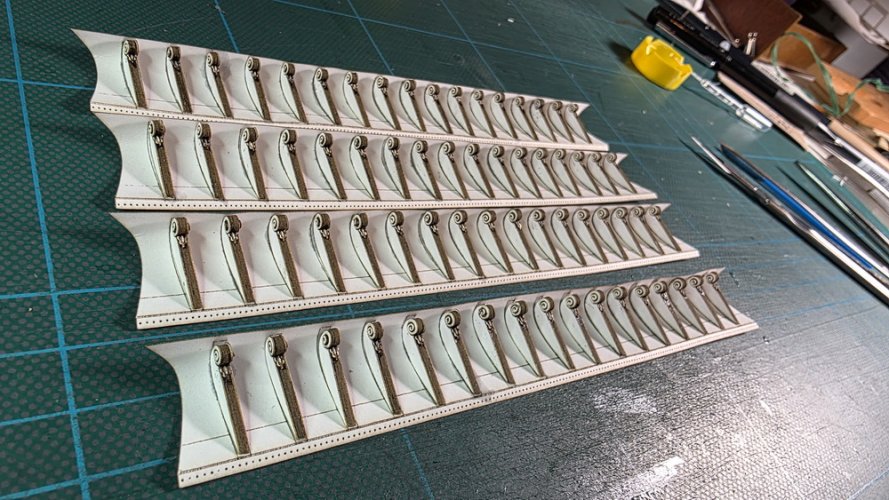
I thought to be at a good point and ready to do a test paint...

20251110_184617.jpg

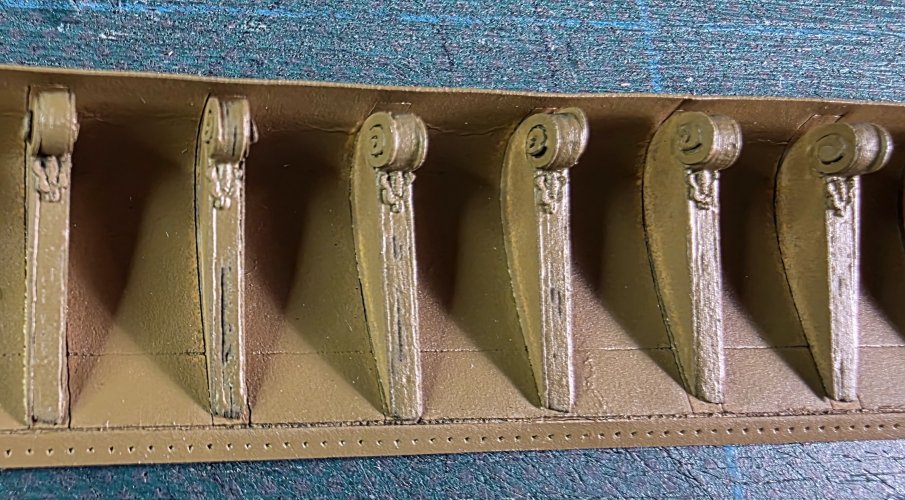
But the worst of the issues is just around the corner... the paint was absorbed by the cut surface, the cardboard has a porous structure in the cut side and the result was horrible... I had to figure out how to fix this...

20251123_105310.jpg

The only solution was to realize a new front side for the supports, taking the opportunity to adding further details to the front of the "curls"

20251121_181706.jpg

This way all the surfaces will take the paint in a regular way

20251121_184219.jpg

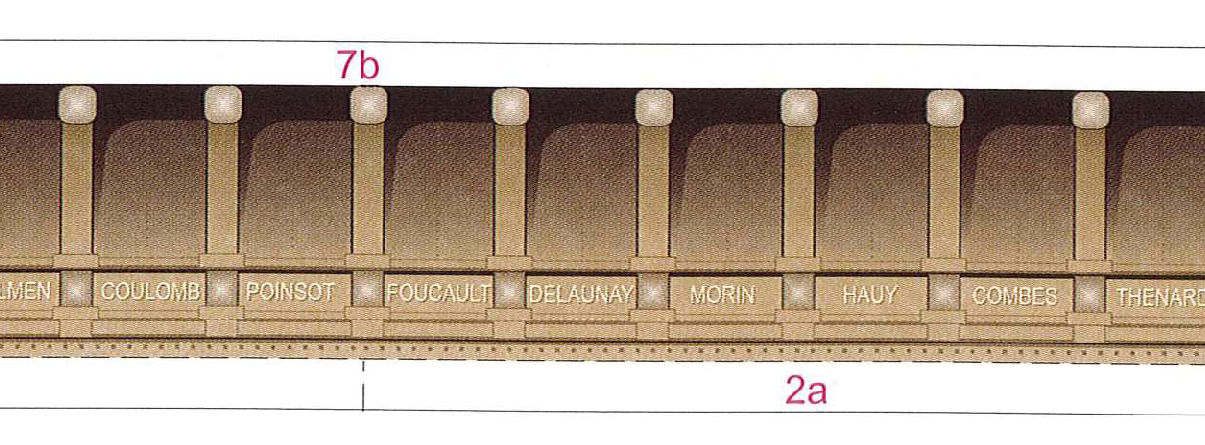
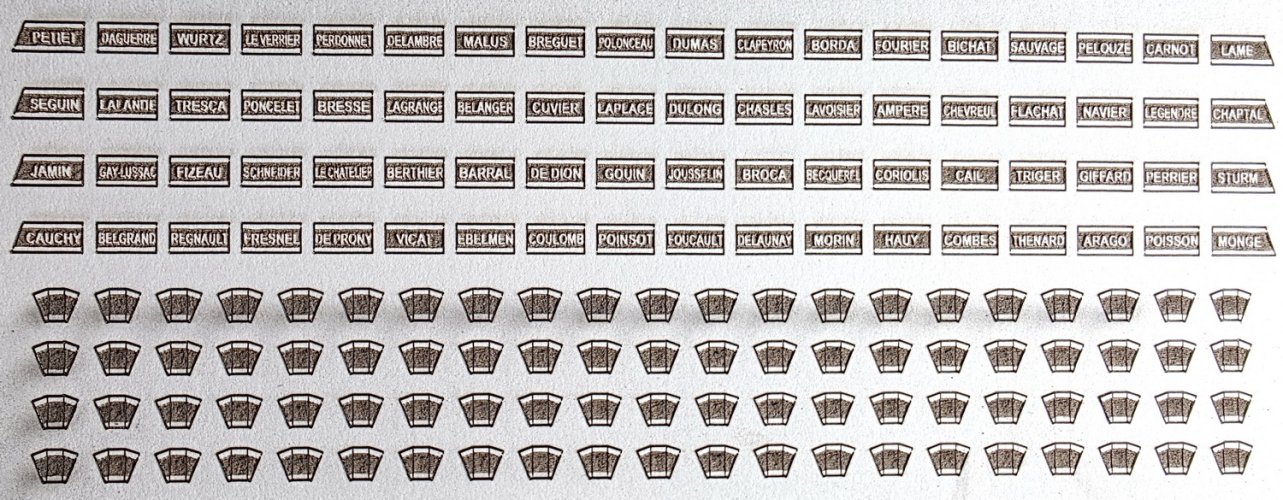
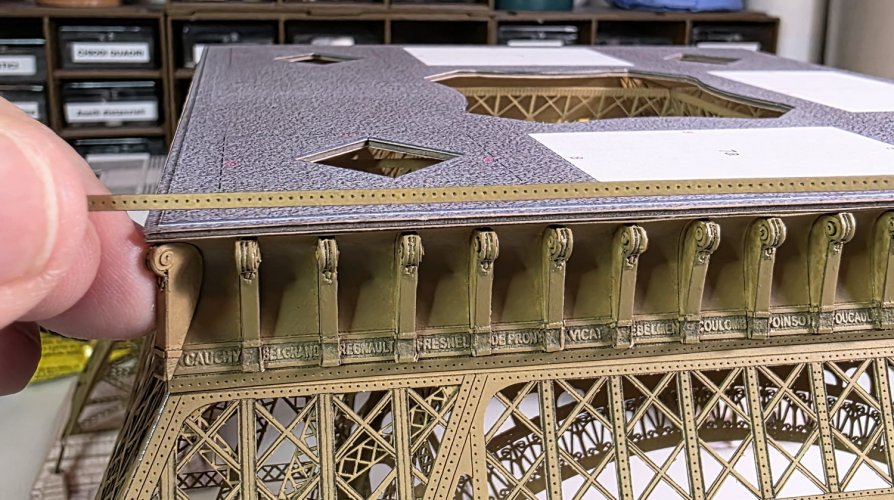
Now there is a last thing to do: the plates with the names of the French scientists that surrounds the four walls. The names in the Schreiber model were not correctly written: I found the right form and sequence of the names in a wikipedia page specifically dedicated to this argument. Drawing the plates and exporting them to the laser cutter was not a difficult task.


20251201_124750.jpg

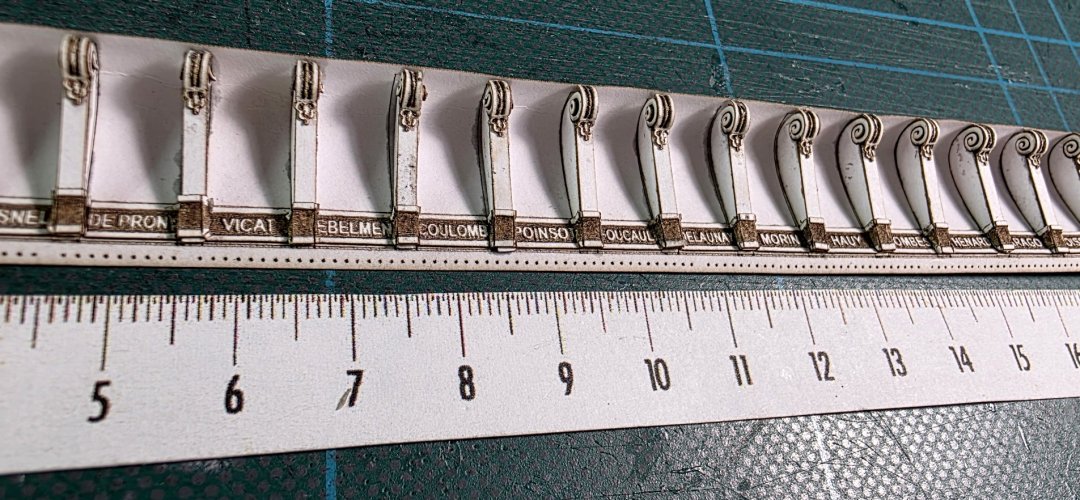
A little more complex task was to place them one by one along the walls...

20251212_182838.jpg

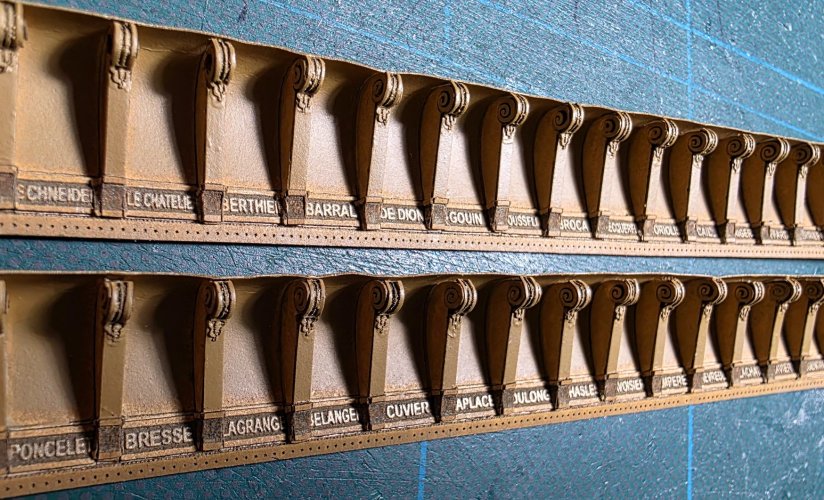
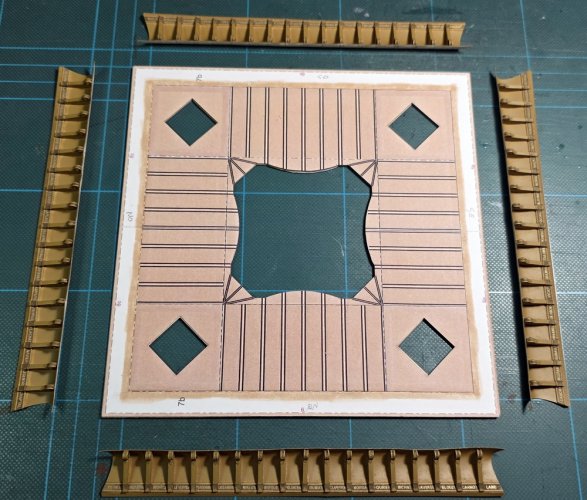
Now, after a new paint job and with some touches with a gold pencil to enhance the embossed names, the walls are ready to be mounted in place.

20251218_184311.jpg
 
... and, just to add troubles to my work, I thought it would be nice to add the decorative leaves...

View attachment 230131

The laser did the hard work but also I had my part: to manipulate and paste those little things was not an easy task with my big fingers...

View attachment 230132

I thought to be at a good point and ready to do a test paint...

View attachment 230133

But the worst of the issues is just around the corner... the paint was absorbed by the cut surface, the cardboard has a porous structure in the cut side and the result was horrible... I had to figure out how to fix this...

View attachment 230134

The only solution was to realize a new front side for the supports, taking the opportunity to adding further details to the front of the "curls"

View attachment 230135

This way all the surfaces will take the paint in a regular way

View attachment 230136

Now there is a last thing to do: the plates with the names of the French scientists that surrounds the four walls. The names in the Schreiber model were not correctly written: I found the right form and sequence of the names in a wikipedia page specifically dedicated to this argument. Drawing the plates and exporting them to the laser cutter was not a difficult task.


View attachment 230137

A little more complex task was to place them one by one along the walls...

View attachment 230138

Now, after a new paint job and with some touches with a gold pencil to enhance the embossed names, the walls are ready to be mounted in place.

View attachment 230139
WOWWWWWWWW!!!!!!

:surprise::surprise::surprise::surprise::surprise::surprise:

:BRAVO::BRAVO::BRAVO:
 
  • Like
Reactions: Tonino
Incredible detailing. The texture, the detailing really adds life to this work of art. ;)
 
  • Like
Reactions: Tonino
Yes! I use edge covering like this often on my builds. Simple fix, easy and highly adaptive. Stunning work, Tonino! :)
 
  • Like
Reactions: Tonino