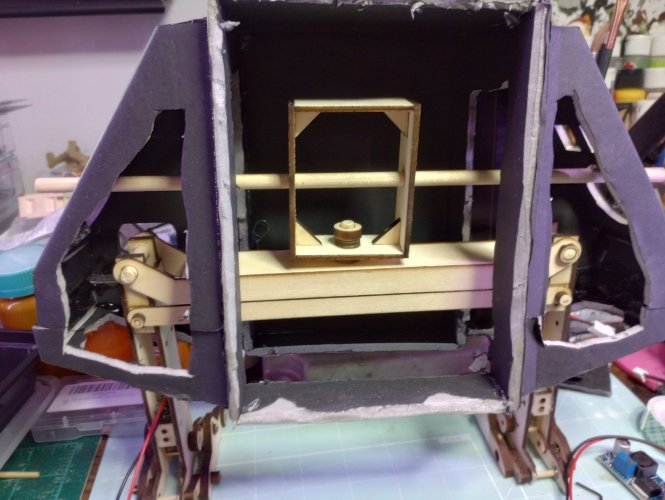

Silent Running "Dewey" drone walker robot with electronics

ShadowCory

Senior Member
Oct 25, 2021
69
189
59
Hi,
It's been awhile. This is a design I originally made from cardstock, but I have always wanted an actual working version. I have really been inspired by RobotHut, who has made several versions of all of the drones, some full scale. The challenge for me has been how to achieve the walking mechanism simply, but also have that distinct gait and movements of these guys. There have been so many awesome builds of the drones over the years, so I don't really know if I'll add to that list, but, as most of my projects are, I just can't not do it.
The first thing I decided was to fake it. The walking mechanism that is. I'm sure that there are ways to use some sort of bipedal mechanism that actually does as the movie portrays, but that's way over my head. I can, however fake the motivating mechanics with two triangular four bar mechanisms, one in each foot, and use a telescoping "shell" on each leg that will be like a hollow pants leg of sorts. Although there will actually be two feet on the ground at all times, it will mimic the the kind of weight tossing gait of the original props.
I've been working on this for years, but more so over the last year. I'll post some catchup project photos and videos, but here is a pic of the card model design:
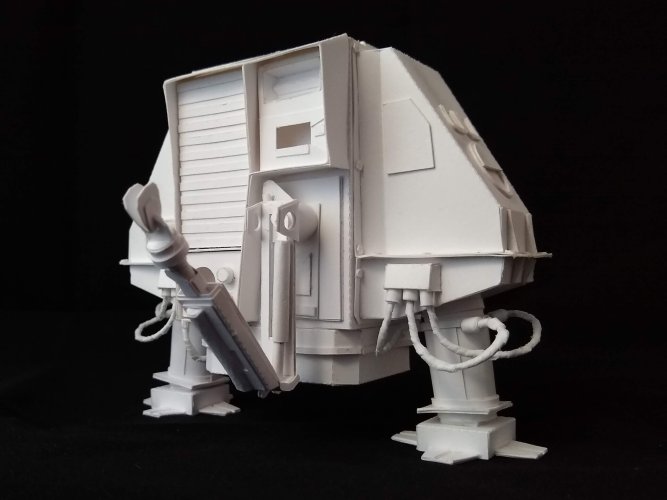
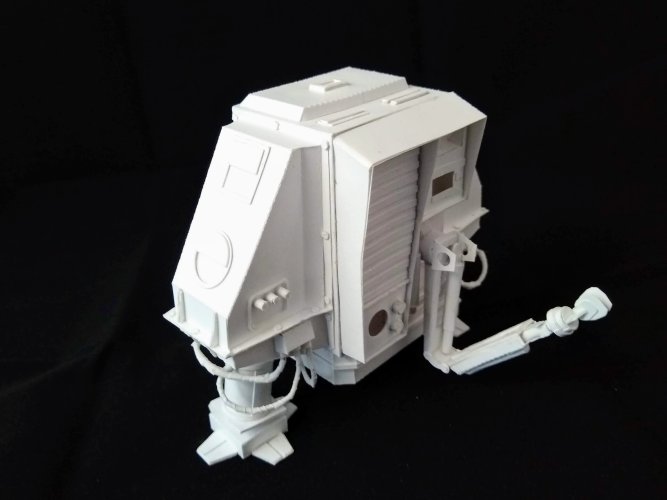
cory-collins-img-20201012-151351954.jpgcory-collins-img-20201012-151409705.jpg

Screenshot from 2025-11-18 23-35-00.png

That's about all I can squeeze out tonight.
 
I have to say that I really like these robots. I have built UHU-02's version of them (as a gift for my wife).
I have to say that you have caught my interest in this project. I am curious to see how you are going to apply the internal robotics systems to this model, in order to make it a working "robot".
1763560755067.gif
 
  • Like
Reactions: ShadowCory
Last edited:
I have to say that I really like these robots. I have built UHU-02's version of them (as a gift for my wife).
I have to say that you have caught my interest in this project. I am curious to see how you are going to apply the internal robotics systems to this model, in order to make it a working "robot".
View attachment 229262
Thats a great idea to make it walk. Im hone keep an eye on this one.
Here is a little preview of the mechanism:
deweyInternal.jpg

View attachment deweyFrameTest.mp4
 
I had a limit switch on each leg, that would supposedly stop one leg, then fire the other until it hits it's limit switch. It can go frontwards, backward, and "steer" by slowing the cycle on one side. The problem here, is the limit switches were not reliably triggered. So, I now have a hall effect sensor on each foot, so there isn't a physical switch that takes torque away from the motors, and triggers more reliably.
The body will be mounted on a pivot and use some servos to tilt forward, backward, left, right, squat down and sit up.
That's the idea anyhow, lol.
 
  • Like
Reactions: zathros and mijob
Pretty good thought process you got going on in that head on yours! :)
 
  • Like
Reactions: ShadowCory
I'm revamping the control modules. The first versions are too big and heavy, so I'm moving from Arduino and big old motor drivers to esp32 modules. Much lighter, more powerful, the esp32 has all the items to create a control system with wifi, Bluetooth, lotsa ram and processing power. Also switching from l298n motor drivers to some much lighter and efficient drivers. I will have to stop frying them tho...I get my wires crossed every now and then and blow something up. I'll keep you updated,lol
 

Attachments

  • 20251126_082318-COLLAGE.jpg
    20251126_082318-COLLAGE.jpg
    1.1 MB · Views: 3
I've been wanting to get into the Arduino scene, but technology is pulling me in the other direction. I am starting to repair all of my Tube amplifiers. I found out one that I have is worth around $2500 bucks not working. I was offered $5K for a 1961 H.H. Scott LC290 Laboratory Amplifier, it goes down to 10 Hz, and all the way up to 28K Hz. I have the complete system, with the pre-amp and FM Tuner. The offer was just for the amp. This one needs no work, and sounds fantastic. Gold Anodized, it's quite pretty to look at. I will probably make my own DAC (Digital to Analog Converter), as there are some kits out there that when built, are twice as good as one for the same price pre-built.

On the other hand, there is one of the best ones made for $289, I just have to many projects going on, and my pockets seem to be a bit shallow. :)
 
Oh, and I want to exchange the bulky nano/joysticks/buttons to the esp32 with a little tft touch screen. Then I can add or subtract buttons and controls. If I can figure out the code for them
I've been wanting to get into the Arduino scene, but technology is pulling me in the other direction. I am starting to repair all of my Tube amplifiers. I found out one that I have is worth around $2500 bucks not working. I was offered $5K for a 1961 H.H. Scott LC290 Laboratory Amplifier, it goes down to 10 Hz, and all the way up to 28K Hz. I have the complete system, with the pre-amp and FM Tuner. The offer was just for the amp. This one needs no work, and sounds fantastic. Gold Anodized, it's quite pretty to look at. I will probably make my own DAC (Digital to Analog Converter), as there are some kits out there that when built, are twice as good as one for the same price pre-built.

On the other hand, there is one of the best ones made for $289, I just have to many projects going on, and my pockets seem to be a bit shallow. :)
Well I think it's great you are keeping a great analog tech alive for future generations. Yeah, I have about three projects juggling all of time ensuring that all fail equally :)
 
Update: It's taking me a shite tonne of time to figure out the logic and coding for the esp32 devices. Chatgpt is not a good coder, fyi. It's good for a simple set of instructions, but once it goes down the wrong road, it just collapses to gibberish, lol. Searching and reading/watching tutorials seems to be better. Once I get a handle on this part, I hope to move faster on the construction. Hope, lol.

You can see I have the motor homing first, then just running a test loop where it detects the magnet, then reverses direction. This is great, but I keep running into problems when I try add the second motor and sensor. I'm probably missing something important about the voltage requirements and wiring the sensors. Some things seem ok, but then others seem to fail for no reason. Or my state machine is using bad logic. I'll work it out. I just requested a service to help me get the controls working. We'll see how much it costs, lol!

View attachment VID_20251129_091438742.mp4
 
I used to write Code for large CNC machines. I converted a large portion of Sikorsky Aircraft tape driven binary light reading tape machines to digital. More often than that, I just wrote a new program to make the parts. I also designed fixtures, all the Master Machinists CNC sh*t that really does not help much in private life, as the cheapest machines cost 1/2 million bucks, and that was in the mid to late 1980's to early 1990's. A lot of the software was propriety code, which was a P.I.A.. When I programmed a few machines in BASIC, I got into all kinds of trouble, as the other employees only could use the menu display type of programming, and could not, would not, learn code. They felt the was the manufacturing engineers job. I was hated and love there. People loved me enough, then after they got what they wanted out of me, the would stab me in the back. I left that company, and the workers there never heeded what I said, "Your jobs are competing with the world", so I wasn't surprised when Sikorsky sent around 3000 of those jobs to Poland and another couple of thousand to other companies, installed a demerit system. Just wanting to press a button and load a apart, and read the newspaper in between is not very competitive.

I hate the way 3D printers are set up, they use G-Codes for everything, instead of separating "M" codes for machine functions, so the programs are mess, do not allow for stopping the program at a predetermined point, then placing a block, so you aren't printing in air. You have to print the support as you build up the part. This wastes a lot of extrusion material, and some of that stuff gets expensive. There are ways of programming these machines using proprietary languages, but I'm just too old, and don't want to invest the time, so I just use the(in my case) Creality software for my K1 Max 3D printer.

Your 3D printing skills are quite impressive. :)